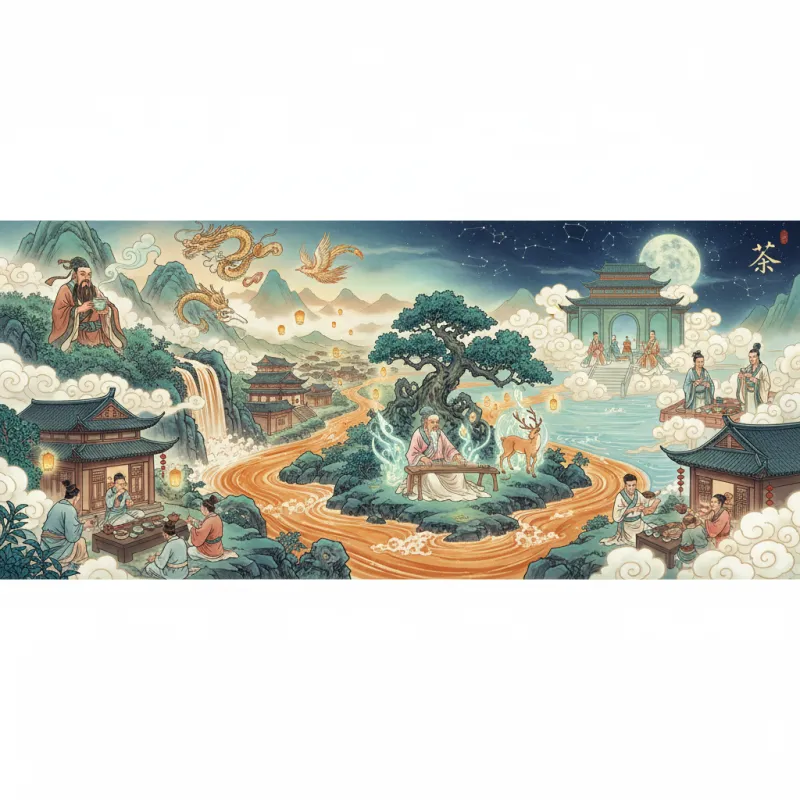
The old tea master's hands moved with the precision of a calligrapher, pouring water from a height that would make most people nervous. "If you rush the leaves," he told me in a Hangzhou teahouse, "they'll punish you with bitterness." He was talking about 龙井 (Lóngjǐng, Dragon Well tea), but he might as well have been describing the entire philosophy of Chinese tea culture — a tradition where patience isn't just a virtue, it's the whole point.
From Medicine to Meditation: Tea's Transformation
茶 (Chá, tea) didn't start as the refined cultural practice we know today. During the Shang Dynasty (1600-1046 BCE), tea leaves were likely chewed or used in medicinal broths — more pharmacy than poetry. The legendary 神农 (Shénnóng, the Divine Farmer) supposedly discovered tea around 2737 BCE when wild leaves fell into his boiling water, but this origin story tells us more about how the Chinese wanted to remember tea than how they actually found it.
The real revolution came during the Tang Dynasty (618-907 CE), when 陆羽 (Lù Yǔ) wrote the 茶经 (Chájīng, The Classic of Tea) in 760 CE. This wasn't just a how-to manual — it was a manifesto that elevated tea from beverage to art form. Lu Yu specified everything: the ideal water source (slow-moving mountain springs), the proper vessel material (Yixing clay), even the correct state of mind (calm, focused, present). His work transformed tea drinking from a practical habit into a spiritual practice, much like how Chinese calligraphy evolved from simple writing into meditation.
The Six Families: Understanding China's Tea Taxonomy
Western tea culture often reduces Chinese tea to "green" or "black," but this is like describing Chinese cuisine as "food." China recognizes six main categories of tea, each defined by its oxidation level and processing method:
绿茶 (Lǜchá, Green Tea) is the least oxidized, with leaves heated immediately after picking to halt fermentation. 龙井 (Lóngjǐng) from Hangzhou and 碧螺春 (Bìluóchūn, Green Snail Spring) from Suzhou represent the pinnacle of this category — delicate, vegetal, and unforgiving of poor brewing technique.
白茶 (Báichá, White Tea) undergoes minimal processing, simply withered and dried. The famous 白毫银针 (Báiháo Yínzhēn, Silver Needle) consists only of unopened buds covered in white down, harvested during a brief window each spring. It's the most subtle of Chinese teas, which is precisely why connoisseurs prize it.
黄茶 (Huángchá, Yellow Tea) is green tea's mysterious cousin, subjected to a unique "sealing yellow" process that creates a mellower, slightly sweet flavor. It's the rarest category, with production secrets closely guarded by a handful of families in Hunan and Anhui provinces.
乌龙茶 (Wūlóngchá, Oolong Tea) occupies the middle ground between green and black, partially oxidized to varying degrees. The range is enormous: from the floral 铁观音 (Tiěguānyīn, Iron Goddess of Mercy) to the heavily roasted 大红袍 (Dàhóngpáo, Big Red Robe), which legend says grew from bushes that cured a Ming Dynasty emperor's mother.
红茶 (Hóngchá, Red Tea) — what the West calls "black tea" — is fully oxidized. The Chinese actually call Western-style black tea "red tea" because of the color of the brewed liquid, not the dried leaves. 祁门红茶 (Qímén Hóngchá, Keemun) from Anhui Province is considered the finest, with a wine-like complexity that develops over multiple infusions.
黑茶 (Hēichá, Dark Tea) is post-fermented, aged like wine. 普洱 (Pǔ'ěr) from Yunnan Province is the most famous example, compressed into cakes that can age for decades. Some collectors treat vintage Pu'er like investment-grade Bordeaux, with prices to match.
Gongfu Cha: The Art of Paying Attention
功夫茶 (Gōngfū Chá, literally "making tea with skill") isn't about kung fu fighting — it's about the kind of focused attention that martial arts require. This brewing method, perfected in Fujian and Guangdong provinces during the Ming Dynasty (1368-1644), uses small clay teapots, tiny cups, and multiple short infusions to extract every nuance from high-quality leaves.
The first infusion is often discarded — a rinse to "wake the leaves" and warm the vessels. Subsequent infusions last anywhere from 15 seconds to two minutes, with timing adjusted based on the tea's response. A skilled practitioner can coax eight to twelve distinct infusions from a single portion of good oolong, each revealing different flavor notes as the leaves gradually unfurl.
This isn't efficiency — it's the opposite. Gongfu cha deliberately slows you down, forcing attention to details most people miss: the way steam rises from the cup, how the liquor's color shifts between infusions, the evolving aroma as leaves open. It's meditation disguised as beverage preparation, similar to the mindfulness practiced in Chinese tea ceremonies that influenced Japanese tea culture.
Regional Identities: Where Terroir Meets Tradition
Chinese tea culture is intensely regional, with provinces fiercely protective of their signature varieties. Fujian Province alone produces white, oolong, and black teas, each from different microclimates and cultivars. The 武夷山 (Wǔyí Shān, Wuyi Mountains) region is so renowned for rock oolongs that tea from specific cliffs commands astronomical prices — not marketing hype, but genuine terroir differences that experts can taste blind.
Yunnan Province's relationship with tea goes deeper than Pu'er production. The province is home to ancient tea trees, some over 1,000 years old, still producing leaves. These 古树茶 (Gǔshù Chá, ancient tree tea) plants have root systems that reach deep into mineral-rich soil, creating flavor profiles impossible to replicate with plantation-grown bushes. Visiting these trees feels less like agriculture and more like pilgrimage.
Hangzhou's West Lake region produces 龙井 (Lóngjǐng), but only tea from specific villages around the lake can legally use the name. The best comes from 狮峰山 (Shīfēng Shān, Lion Peak Mountain), where the combination of soil, humidity, and temperature creates the perfect conditions for the flat, jade-colored leaves. Locals will tell you they can taste which side of the mountain tea came from — and they're not entirely wrong.
Tea and Philosophy: Brewing Enlightenment
Buddhism, Taoism, and Confucianism all found something useful in tea. Buddhist monks used it to stay awake during meditation, eventually developing elaborate tea ceremonies that spread to Japan. The connection between 禅 (Chán, Zen Buddhism) and tea became so intertwined that the phrase "茶禅一味" (Chá Chán Yī Wèi, "tea and Zen are one taste") became a common saying.
Taoists appreciated tea's ability to clarify the mind without agitation — unlike alcohol, which clouds judgment, or coffee, which creates jittery energy. Tea offered 清 (qīng, clarity), a state of alert calmness that aligned perfectly with Taoist ideals of natural harmony. The famous Taoist poet 陆游 (Lù Yóu) wrote over 300 poems about tea, treating it as a path to understanding the 道 (Dào, the Way).
Confucian scholars used tea gatherings as opportunities for refined social interaction, where hierarchy could be acknowledged without being oppressive. The ritual of serving tea — elder before younger, guest before host — reinforced social order while creating space for genuine conversation. These gatherings influenced the development of Chinese scholar culture, where intellectual exchange happened over tea rather than wine.
The Modern Tea Renaissance
Chinese tea culture nearly died during the Cultural Revolution (1966-1976), when traditional practices were condemned as feudal. Teahouses closed, ancient tea trees were cut down, and knowledge passed through generations was deliberately forgotten. The recovery has been remarkable but incomplete — some techniques and cultivars were lost forever.
Today's Chinese tea scene is split between preservation and innovation. In cities like Chengdu and Hangzhou, traditional teahouses thrive alongside modern tea cafés serving 奶茶 (Nǎichá, milk tea) and fruit-infused cold brews. Young Chinese are rediscovering gongfu cha through social media, while simultaneously creating new tea cultures that would horrify purists.
The tension is productive. When a Shenzhen startup uses AI to optimize oolong oxidation levels, they're not abandoning tradition — they're extending it. Chinese tea culture has always evolved, from Tang Dynasty brick tea to Ming Dynasty loose-leaf brewing to Qing Dynasty teahouse culture. The current moment is just another transformation in a 5,000-year conversation about leaves and water.
Drinking History: What Tea Teaches
The old tea master in Hangzhou was right about patience, but he was teaching something deeper than brewing technique. Chinese tea culture is fundamentally about paying attention — to temperature, timing, aroma, color, taste, and the subtle changes between infusions. It's about noticing things that don't announce themselves.
This might be tea's most valuable export, more important than the leaves themselves. In a world optimized for speed and efficiency, tea culture insists that some things can't be rushed. The leaves will open when they're ready. The flavor will develop across multiple infusions. The conversation will deepen as the tea cools.
You can drink tea quickly, of course. You can use tea bags, boiling water, and five-minute steeps. But you'll miss the point, which isn't caffeine or hydration or even flavor. The point is the pause itself — the moment when you stop doing and start noticing. That's what 5,000 years of Chinese tea culture has really been cultivating: the ability to be present for something as simple and profound as hot water meeting leaves.
Related Reading
- The Chinese Tea Ceremony: History and Practice
- The Eight Great Cuisines of China: A Flavorful Tour
- Food Symbolism in Chinese Culture: Every Dish Tells a Story
- Chinese Food Culture: What the World Gets Wrong About Chinese Cuisine
- Why Chinese Food Tastes Different in China: A Culinary Reality Check
- Why Chinese Tea Culture Is Not Japanese Tea Ceremony
- The Century of Humiliation: How China Remembers
- Discovering Love Legends of Chinese Folklore: Tales of Passion and Destiny
Explore Chinese Culture
- Explore feng shui in daily life
- Explore supernatural folklore
- Explore classical Chinese literature