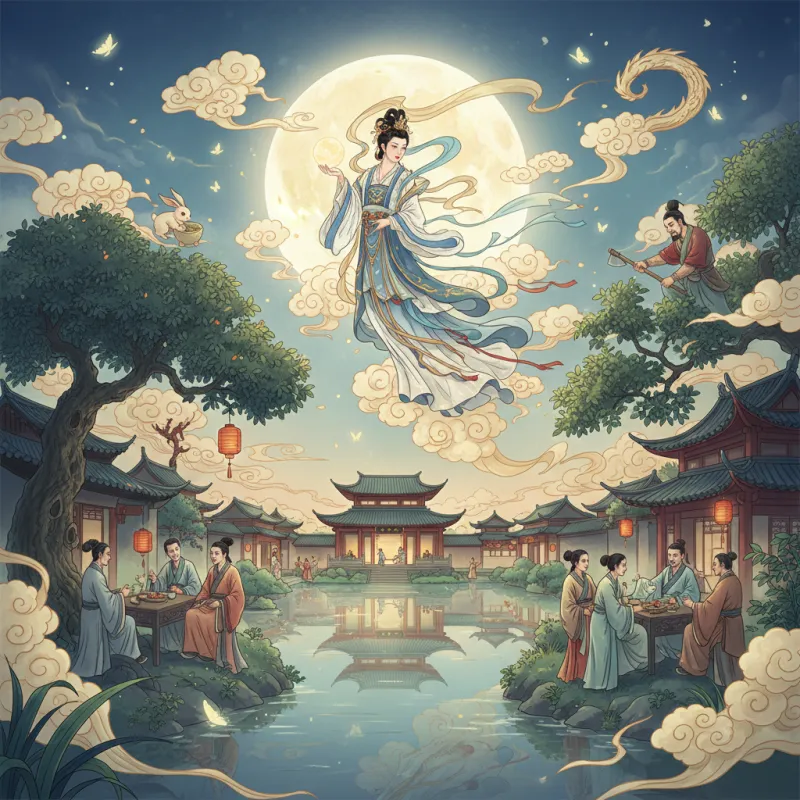
The moon hangs impossibly round above the courtyard, and across China, millions of families tilt their heads skyward at the same moment. They're not just looking at the moon — they're looking through it, seeing absent relatives, remembering childhood homes, contemplating the strange mathematics of time and distance that scatter families across provinces and continents. This is 中秋节 (Zhōngqiū Jié, Mid-Autumn Festival), the night when longing becomes a shared ritual.
The Moon at Its Most Persuasive
Mid-Autumn Festival falls on the fifteenth day of the eighth lunar month, when the moon reaches peak fullness and brightness. The timing isn't arbitrary — autumn's clear, dry air creates optimal viewing conditions, and the harvest season provides both leisure and abundance. Ancient astronomers knew what they were doing when they designated this particular full moon as special.
The festival ranks second only to Spring Festival in cultural importance, but the two holidays couldn't feel more different. Spring Festival explodes with firecrackers, red envelopes, and marathon meals. Mid-Autumn Festival whispers. It's contemplative rather than celebratory, oriented toward the sky rather than the table, suffused with a melancholy that Chinese aesthetics have always valued alongside joy.
Historical records place moon worship rituals back to the Zhou Dynasty (1046–256 BCE), but the festival as we know it crystallized during the Tang Dynasty (618–907 CE), when poets like Li Bai made lunar longing fashionable. By the Song Dynasty (960–1279), the fifteenth of the eighth month was officially designated 中秋, and the customs we recognize today — mooncakes, moon-gazing, legend-telling — became standardized across social classes.
Mooncakes: Edible Symbolism
月饼 (Yuèbǐng, mooncakes) are the festival's signature food, and they're designed to be admired before eaten. Round like the full moon, they embody 团圆 (tuányuán, reunion and completeness), the festival's emotional core. Traditional mooncakes feature intricate surface patterns — often the characters for "longevity" or "harmony," sometimes images of the moon palace or Chang'e herself.
The filling matters. Classic Cantonese-style mooncakes contain lotus seed paste and salted egg yolk, the yolk representing the moon floating in darkness. Suzhou-style mooncakes favor savory pork fillings. Beijing-style mooncakes use sesame and walnut. Regional variations multiply endlessly, each locale insisting its version is the authentic one.
Modern mooncakes have gone rogue. You'll find ice cream mooncakes, chocolate mooncakes, even mooncakes filled with Spam (a Hong Kong innovation that somehow works). Luxury brands release mooncakes in elaborate gift boxes that cost more than the average monthly salary. The mooncake has become a vehicle for conspicuous consumption and corporate gifting, which feels both inevitable and slightly sad.
But here's what matters: mooncakes are meant to be shared. You don't eat a whole mooncake alone — they're too rich, too dense, too symbolically weighted. You cut them into wedges and distribute them among family members, friends, colleagues. The act of division creates connection, which is the point.
Chang'e: The Moon's Reluctant Resident
Every Mid-Autumn Festival, families retell the legend of 嫦娥 (Cháng'é), the woman who lives on the moon. The story has multiple versions, but the core narrative goes like this: Chang'e was married to 后羿 (Hòu Yì), a legendary archer who shot down nine of ten suns that were scorching the earth. As a reward, he received an elixir of immortality.
Chang'e drank the elixir — accounts differ on whether this was accidental, desperate, or selfish — and floated up to the moon, where she remains forever, accompanied only by a jade rabbit who pounds medicine with a mortar and pestle. Hou Yi, left behind on earth, can only gaze at the moon and grieve.
This is not a happy story. Chang'e achieves immortality but loses everything that made immortality desirable. She's trapped in a palace of cold jade, eternally separated from her husband, her sacrifice (or theft, depending on the version) yielding only isolation. The legend resonates because it captures something true about difficult choices and their irreversible consequences.
The jade rabbit, 玉兔 (Yùtù), adds a surreal touch. Why is there a rabbit on the moon? Chinese observers saw a rabbit shape in the moon's dark patches (where Western cultures see a man's face), and folklore filled in the explanation. The rabbit's endless medicine-pounding suggests futile labor, cosmic bureaucracy, the way immortals must occupy eternity with repetitive tasks.
Moon-Gazing as Social Practice
赏月 (Shǎngyuè, moon appreciation) is the festival's central activity, and it's more structured than it sounds. Families arrange tables in courtyards or on balconies, positioning them to face the moon. They set out offerings — mooncakes, pomegranates, persimmons, osmanthus wine — and light incense. Then they sit together and look up.
What are they looking at, exactly? The moon, obviously, but also everything the moon represents: distance, longing, the passage of time, the people who aren't present. The full moon becomes a screen for projection, a mirror for emotion. Tang Dynasty poet Li Bai famously wrote, "举头望明月,低头思故乡" (Jǔ tóu wàng míngyuè, dī tóu sī gùxiāng) — "I lift my head to gaze at the bright moon, I lower my head and think of home."
This is why Mid-Autumn Festival hits differently for people living away from their hometowns. The moon is the same everywhere, which makes it the perfect symbol for connection across distance. When you look at the moon, you know your family is looking at the same moon, and that shared gaze creates a kind of communion.
Modern celebrations have adapted. Families video call across time zones, holding up their phones to show each other their respective moons. Parks host moon-viewing parties with traditional music performances. Cities compete to create the most Instagram-worthy moon-themed light installations. The ritual persists, even as the context shifts.
Lanterns, Pomelos, and Regional Variations
While mooncakes and moon-gazing are universal, regional customs add local flavor. In southern China, children carry lanterns during evening processions, the lanterns' glow echoing the moon's light. Traditional lanterns were made of paper stretched over bamboo frames, shaped like rabbits, carps, or lotus flowers. Modern versions include battery-powered plastic lanterns featuring cartoon characters, which purists lament but children adore.
Pomelos (柚子, yòuzi) appear on Mid-Autumn Festival tables across southern provinces. The fruit ripens in autumn, and its Chinese name sounds like "blessing" (佑, yòu), making it symbolically appropriate. After eating the flesh, children wear the hollowed-out rind as a hat, a tradition that looks ridiculous and delightful in equal measure.
In Hong Kong, the festival includes 舞火龙 (wǔ huǒlóng, fire dragon dances), where teams carry a dragon made of straw and incense sticks through narrow streets, the incense creating a river of sparks. The tradition supposedly originated as a plague-prevention ritual in the 1880s and has persisted as spectacular folk theater.
Taiwan's Mid-Autumn Festival has become synonymous with outdoor barbecues, a relatively recent tradition that started in the 1980s, possibly influenced by a barbecue sauce advertising campaign. Now families gather in parks and on sidewalks, grilling meat under the full moon, the smoke mingling with incense and osmanthus fragrance.
The Festival in Contemporary Life
Mid-Autumn Festival occupies an interesting position in modern Chinese culture. It's not as commercially dominant as Spring Festival or as youth-oriented as Qixi Festival, but it maintains steady relevance across generations. The holiday's emphasis on family reunion aligns with enduring cultural values, even as family structures and geographic mobility patterns change.
The mooncake market has become absurdly inflated, with luxury brands treating mooncakes as status symbols rather than food. Gift boxes can cost thousands of yuan, featuring gold leaf, premium ingredients, and packaging more elaborate than the contents. This commercialization coexists uneasily with the festival's traditional emphasis on simplicity and contemplation.
Yet the core ritual — looking at the moon together — resists commodification. You can't monetize shared silence or the particular quality of autumn moonlight. The festival survives because it offers something increasingly rare: permission to pause, to feel melancholy without needing to fix it, to acknowledge that distance and longing are part of the human condition.
Why the Moon Still Matters
In an era of instant communication and cheap flights, you might expect a festival centered on separation and longing to feel obsolete. Instead, Mid-Autumn Festival has gained resonance. Modern life scatters families more thoroughly than ever — not just across provinces but across continents and time zones. The moon remains the one thing everyone can see, the universal reference point.
The festival also preserves a particular emotional register that contemporary culture often dismisses. 乡愁 (Xiāngchóu, homesickness or nostalgia) is a legitimate feeling, not a problem to be solved. The melancholy of looking at the moon and thinking of absent loved ones isn't depression — it's recognition of connection's value, made visible through its temporary absence.
When families gather for Mid-Autumn Festival, they're participating in a ritual that stretches back over a thousand years, connecting them to ancestors who looked at the same moon and felt the same complex mixture of joy and sadness. The mooncakes might be filled with Spam now, and the lanterns might feature cartoon characters, but the essential gesture remains: looking up together, acknowledging what's present and what's absent, finding beauty in both fullness and longing.
The moon doesn't care about any of this, of course. It just keeps orbiting, reaching fullness every month, indifferent to human meaning-making. But on the fifteenth day of the eighth lunar month, for a few hours, millions of people agree to care together, and that agreement creates something real — not quite magic, but close enough.
Related Reading
- Mid-Autumn Festival: Mooncakes and Moon Gazing
- Dragon Boat Festival: Racing for Qu Yuan
- Dragon Boat Festival: Racing, Remembrance and Rice Dumplings
- Chinese New Year Is Not Just a Day (It Is a Whole Season)
- Chinese New Year: The Complete Guide to Spring Festival
- Legendary Heroes of Chinese Folklore: Tales That Shaped Culture and Identity
- Unveiling the Rich Tapestry of Chinese Folklore and Festival Origins
- Wu Wei: The Taoist Art of Doing Nothing (and Getting Everything Done)
Explore Chinese Culture
- Explore feng shui in daily life
- Explore supernatural folklore
- Explore classical Chinese literature