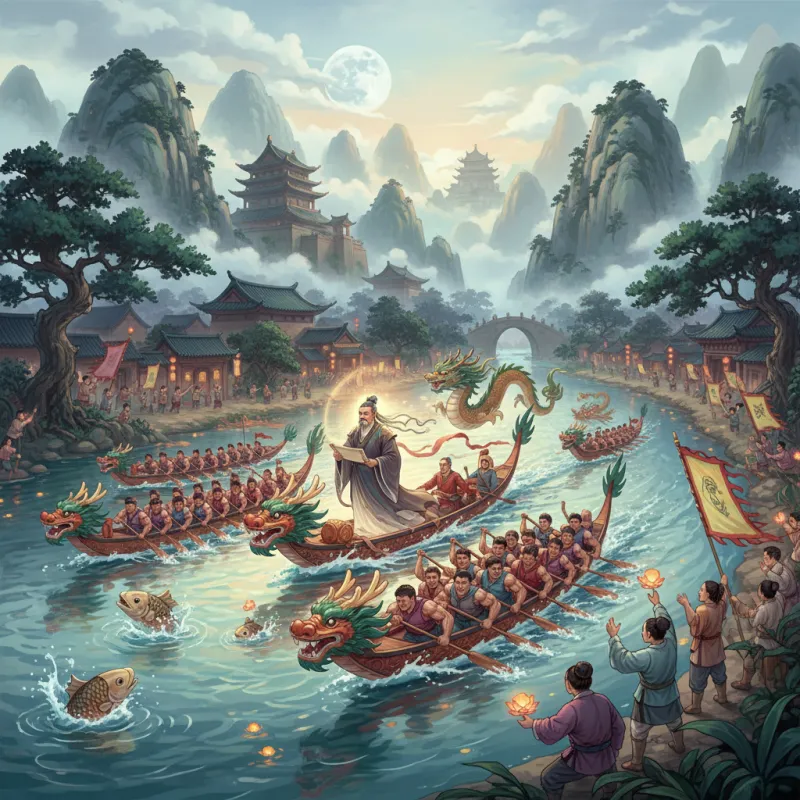
The drums thunder across the water as fifty paddlers surge forward in perfect unison, their dragon-headed boat slicing through the waves like a blade. Every fifth day of the fifth lunar month, rivers across China explode with this primal energy—but few spectators realize they're witnessing a 2,300-year-old act of collective grief. The Dragon Boat Festival, or Duanwu Jie (端午节, Duānwǔ Jié), isn't just about racing. It's about a poet who chose drowning over dishonor, and a people who've been trying to save him ever since.
The Poet Who Wouldn't Compromise
Qu Yuan (屈原, Qū Yuán, 340-278 BC) wasn't just any government official—he was the kind of idealist who makes pragmatists nervous. As a minister in the state of Chu during the Warring States period, he advocated fiercely for political reform and alliance-building to counter the rising threat of Qin. But court politics rarely reward the righteous. Slandered by jealous rivals and dismissed by King Huai, Qu Yuan found himself exiled from the capital he'd served with unwavering loyalty.
What makes Qu Yuan's story resonate across millennia isn't just his political downfall—it's what he did with his despair. Rather than fade into bitter obscurity, he channeled his anguish into poetry. His masterwork, "Li Sao" (离骚, Lí Sāo, "Encountering Sorrow"), remains one of Chinese literature's longest and most passionate poems, a 373-line torrent of grief, accusation, and mythological imagery. When Chu's capital fell to Qin forces in 278 BC, Qu Yuan walked into the Miluo River (汨罗江, Mìluó Jiāng) in Hunan Province, clutching a stone to ensure he'd sink. He was roughly sixty-two years old.
The Race Against Death
Here's where legend and ritual collide. Local fishermen, devastated by news of Qu Yuan's suicide, immediately launched their boats to search for his body. They beat drums and splashed their paddles violently to scare away fish and water dragons that might devour the poet's corpse. When they couldn't find him, they threw rice dumplings into the water—offerings to feed his spirit or, in some versions, to distract hungry fish from his body.
This frantic, futile rescue mission became the template for dragon boat racing. The boats themselves, with their ornate dragon heads and tails, invoke the mythical creatures believed to inhabit Chinese waterways. Teams of twenty to fifty paddlers, synchronized by a drummer at the bow, recreate that ancient urgency. Modern races can reach speeds of over 20 kilometers per hour, with elite teams training year-round. But the competitive element, while thrilling, serves a deeper purpose—it's a ritual reenactment of collective care, a community saying "we would have saved you if we could."
Zongzi: Triangular Monuments to Memory
The rice dumplings thrown into the Miluo River evolved into zongzi (粽子, zòngzi), one of China's most distinctive festival foods. These pyramid-shaped parcels of glutinous rice, wrapped in bamboo or reed leaves and tied with string, come in countless regional variations. Northern versions tend toward sweet fillings—red bean paste, jujube dates, or plain rice with sugar. Southern zongzi lean savory, stuffed with pork belly, salted egg yolk, mushrooms, and chestnuts.
Making zongzi is labor-intensive. The leaves must be soaked and cleaned, the rice prepared just right, the wrapping technique mastered through practice. Families often gather the night before Duanwu to assemble dozens or even hundreds of zongzi together, their hands moving in practiced rhythms while they talk and laugh. It's this communal effort that connects modern celebrants to those ancient fishermen—both groups preparing offerings with their own hands, both motivated by love and loss.
The food carries symbolic weight beyond its connection to Qu Yuan. The triangular shape is said to represent the mountains of Chu, Qu Yuan's homeland. The bamboo leaves protect the rice from corruption, just as Qu Yuan's integrity remained intact despite political rot around him. And the act of unwrapping a zongzi—carefully untying the string, peeling back the leaves to reveal the steaming rice within—mirrors the way we must unwrap layers of history to understand the festival's true meaning.
Beyond Qu Yuan: The Festival's Other Faces
While Qu Yuan dominates Dragon Boat Festival narratives, honest history requires acknowledging the festival's pre-existing roots. Archaeological evidence suggests dragon boat racing and fifth-month rituals existed before Qu Yuan's death, possibly as summer solstice celebrations or agricultural rites. Some scholars argue the festival originally honored dragon deities believed to control rain and rivers—crucial concerns for agrarian societies.
The Wu Zixu (伍子胥, Wǔ Zǐxū) theory offers an alternative origin story. This general from the state of Wu was forced to commit suicide in 484 BC, and his body was reportedly thrown into a river. In regions of Jiangsu and Zhejiang, some communities claim they're commemorating Wu Zixu, not Qu Yuan. Then there's Cao E (曹娥, Cáo É), a filial daughter from the Eastern Han Dynasty who drowned herself searching for her father's body in the river—another tale of water, death, and devotion.
Rather than seeing these competing narratives as contradictions, consider them as layers. The Dragon Boat Festival became a container large enough to hold multiple stories of loyalty, sacrifice, and the dangerous boundary between water and land. Qu Yuan's story simply proved the most poetically compelling, the most easily nationalized during periods when China needed symbols of incorruptible patriotism.
Warding Off the Fifth Month's Poison
Traditional Chinese cosmology viewed the fifth lunar month with suspicion. The summer heat brought disease, insects, and spoiled food. The number five itself, repeated in the date (fifth day of the fifth month), was considered especially inauspicious—too much yang energy creating imbalance. Dragon Boat Festival thus incorporated numerous apotropaic practices to ward off evil and illness.
Households hang calamus (菖蒲, chāngpú) and mugwort (艾草, àicǎo) above their doors, the plants' strong scents believed to repel insects and malevolent spirits. Children wear perfume pouches (香囊, xiāngnáng) filled with aromatic herbs around their necks. In some regions, people drink realgar wine (雄黄酒, xiónghuáng jiǔ), though this practice has declined due to the wine's arsenic content—turns out not all traditional remedies survive modern chemistry.
The festival also features colorful silk threads tied around children's wrists, ankles, or necks, meant to protect them from disease and bad luck. These threads stay on until the first rain after the festival, when they're cut off and thrown into the water—symbolically carrying away any accumulated misfortune. It's a reminder that Chinese festivals rarely serve single purposes; they're multifunctional events addressing spiritual, social, medical, and seasonal concerns simultaneously.
The Festival in Modern China
Today's Dragon Boat Festival carries official weight—it's been a public holiday in mainland China since 2008, part of a broader effort to preserve and promote traditional culture. Major cities host elaborate racing competitions with corporate sponsors and international teams. The festival has even gone global, with dragon boat racing clubs in dozens of countries, though many participants know little about Qu Yuan.
This globalization raises interesting questions about cultural authenticity and evolution. When a Malaysian team races in Singapore, are they participating in Chinese culture, or has dragon boat racing become something new—a sport that happens to have Chinese origins, like how pizza is now global despite its Italian roots? The answer probably lies somewhere in between, in that messy space where tradition meets adaptation.
What remains constant is the festival's core emotional register: remembrance, community, and the human impulse to honor those who suffered for their principles. Whether you're wrapping zongzi with your grandmother in Hunan or paddling in a corporate team-building race in California, you're participating in a ritual that says loyalty matters, sacrifice deserves commemoration, and some stories are worth keeping alive across millennia.
Racing Toward What?
The Dragon Boat Festival forces a question that most celebrations avoid: what do we do with noble failure? Qu Yuan didn't win. His political vision collapsed, his king ignored him, his state fell to invaders. He died alone in a river, and no amount of frantic paddling could change that outcome. Yet here we are, 2,300 years later, still racing toward his memory.
Perhaps that's the point. The festival doesn't celebrate success—it honors the attempt, the refusal to compromise, the choice to drown rather than live dishonorably. In an era that often prioritizes pragmatism over principle, there's something almost subversive about a national holiday dedicated to a man who chose the losing side because it was the right side.
The drums will thunder again this year, the zongzi will be wrapped and unwrapped, and somewhere a child will ask why we're racing boats to remember a sad poet. The answer isn't simple, but it's worth giving: because some people are worth remembering, some losses are worth mourning, and some races are worth running even when you know you can't win. That's what Qu Yuan teaches us from the bottom of the Miluo River, and that's why we keep paddling toward him, year after year, knowing we'll never quite reach him but unable to stop trying.
For more on Chinese festival traditions, explore the Mid-Autumn Festival and its own tales of separation and longing, or discover how Chinese New Year marks beginnings while Duanwu commemorates endings.
Related Reading
- Mid-Autumn Festival: Mooncakes and Moon Gazing
- Chinese Festivals: The Calendar That Runs on Stories
- Dragon Boat Festival: Racing, Remembrance and Rice Dumplings
- Chinese New Year: The Complete Guide to Spring Festival
- The Enchanting World of Chinese Folklore: Legends and Cultural Traditions
- Unveiling the Rich Tapestry of Chinese Folklore and Legends
- Exploring the Rich Tapestry of Chinese Folklore, Legends, and Fairy Tales
Explore Chinese Culture
- Explore feng shui in daily life
- Explore supernatural folklore
- Explore classical Chinese literature