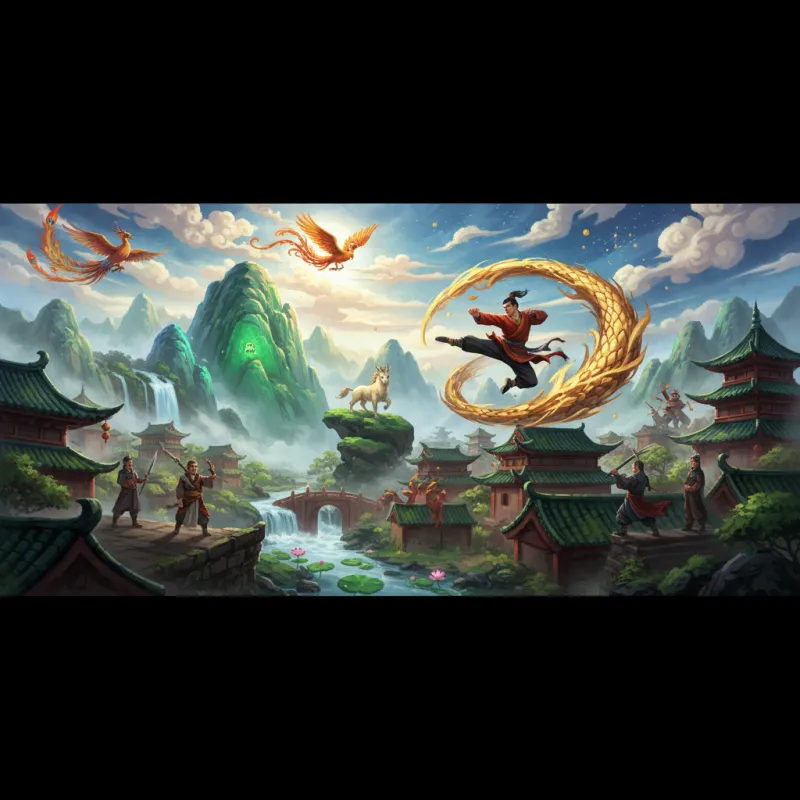
A shirtless man stands in a Roman Colosseum, surrounded by martial artists from around the world. He screams, his body coiled like a spring, then explodes into motion — fists and feet blurring, opponents flying. The year is 1973. The film is Enter the Dragon. The man is Bruce Lee. And in that moment, Chinese cinema kicks down the door of Western consciousness and never looks back.
Before the Dragon: Chinese Cinema's Invisible Years
For decades, Chinese martial arts films thrived in Asia while remaining completely unknown to Western audiences. Shaw Brothers Studio in Hong Kong had been churning out wuxia (武侠, wǔxiá) films since the 1950s — stories of wandering swordsmen, revenge, and honor that drew from centuries of Chinese literary tradition. Directors like King Hu created masterpieces like A Touch of Zen (1971), which would later win the Grand Prix at Cannes, but these films played to packed theaters in Hong Kong, Taiwan, and Southeast Asian Chinatowns, invisible to the mainstream West.
Meanwhile, Chinese characters in Hollywood were relegated to racist caricatures — the sinister Fu Manchu, the subservient houseboy, the exotic dragon lady. Even when martial arts appeared, as in the 1960s Green Hornet TV series, the Chinese sidekick Kato (played by Bruce Lee) couldn't be the star. The message was clear: Chinese people could be mysterious, dangerous, or servile, but never heroic.
Bruce Lee shattered that ceiling with his fists.
The Four Films That Changed Everything
Bruce Lee's Hong Kong career lasted exactly four films as a leading man: The Big Boss (1971), Fist of Fury (1972), Way of the Dragon (1972), and the Hollywood co-production Enter the Dragon (1973). Four films. Three years. One seismic cultural shift.
The Big Boss made him a star in Asia. Fist of Fury made him a legend — the scene where he kicks a sign reading "No Dogs and Chinese Allowed" resonated across the Chinese diaspora, a middle finger to colonial humiliation. Way of the Dragon featured his iconic fight with Chuck Norris in the Colosseum, East meeting West in the ruins of empire. And Enter the Dragon broke through to Western audiences, grossing over $200 million worldwide (equivalent to nearly $1 billion today).
But Bruce Lee wasn't just performing kung fu — he was performing Chinese masculinity on his own terms. Shirtless, muscular, confident, and utterly in control. He spoke English with an accent and didn't apologize for it. He played characters who were Chinese and proud, who fought against oppression and won. For Asian audiences worldwide, especially young men growing up in the West, this was revolutionary. For the first time, they saw themselves as heroes.
He died in July 1973, just weeks before Enter the Dragon premiered in the United States. He was 32 years old. He never knew the full extent of what he'd started.
The Golden Age: When Hong Kong Ruled Action Cinema
Bruce Lee's death could have ended the kung fu film boom. Instead, it triggered an explosion. Hong Kong's film industry, already robust, went into overdrive. By the 1980s, Hong Kong was producing more films per capita than anywhere else on Earth, and kung fu films were its calling card.
The industry split into two dominant styles. First came the traditional wuxia films, elevated by directors like Tsui Hark and choreographers like Yuen Woo-ping. These films featured wire work (威也, diāowēiyǎ) — performers suspended on wires to create gravity-defying combat — and drew heavily from Chinese martial arts traditions and wuxia novels. Jet Li's Once Upon a Time in China series (1991-1997) epitomized this approach, blending historical drama with spectacular action.
Then came Jackie Chan, who took kung fu in a completely different direction. Chan combined martial arts with Buster Keaton-style physical comedy, performing death-defying stunts without wires or CGI. His Police Story (1985) featured a scene where he slid down a pole covered in exploding lights, burning his hands and nearly breaking his back. The outtakes during the credits — showing his injuries and failed stunts — became his signature, proof that every impossible move was real.
Chan's films were lighter than Bruce Lee's, less about Chinese pride and more about universal entertainment. But they were no less influential. By the 1990s, Jackie Chan was one of the most recognizable faces on the planet.
The Wuxia Renaissance: Crouching Tiger's Artistic Triumph
By the late 1990s, kung fu films had become formulaic. Hong Kong's film industry was in decline, losing talent to Hollywood and audiences to Hollywood blockbusters. The genre needed reinvention.
Ang Lee's Crouching Tiger, Hidden Dragon (2000) provided it. Lee took the wuxia tradition and gave it art-house sensibility — stunning cinematography, emotional depth, and Yuen Woo-ping's choreography at its most balletic. The film wasn't just action; it was poetry. The bamboo forest fight between Zhang Ziyi and Michelle Yeoh remains one of cinema's most beautiful sequences.
Crouching Tiger earned $213 million worldwide and won four Academy Awards, including Best Foreign Language Film. It proved that kung fu films could be both commercially successful and critically acclaimed in the West. It opened doors for Zhang Yimou's Hero (2002) and House of Flying Daggers (2004), which pushed visual spectacle even further, turning martial arts into moving paintings.
These films also reconnected kung fu cinema to its roots in Chinese culture and philosophy. The wandering swordsmen of wuxia literature, the Daoist concepts of balance and flow, the Confucian tensions between duty and desire — these weren't just backdrops but the films' thematic cores. Western audiences got a glimpse of Chinese philosophical traditions through the medium of action.
Hollywood Learns to Kick: The Influence Spreads
By the 2000s, Hollywood had stopped trying to compete with kung fu films and started copying them. The Matrix trilogy (1999-2003) hired Yuen Woo-ping as choreographer, bringing wire work and Hong Kong-style fight scenes to American sci-fi. Quentin Tarantino's Kill Bill films (2003-2004) were love letters to Shaw Brothers cinema, complete with yellow jumpsuits homaging Bruce Lee.
Even superhero films got in on the action. The fight scenes in Captain America: The Winter Soldier (2014) and Black Panther (2018) show clear kung fu influence, emphasizing choreography and practical stunts over pure CGI. Marvel hired Chinese stunt coordinators and fight choreographers, recognizing that Hong Kong had perfected something Hollywood was still learning.
The influence went beyond technique. The philosophical underpinnings of kung fu — discipline, self-mastery, the journey from student to master — became central to Western action films. Kung Fu Panda (2008), an American animated film, understood Chinese martial arts philosophy better than many Chinese films, exploring concepts like inner peace and wu wei (无为, wúwéi, effortless action) with surprising depth.
The Modern Era: China's Blockbuster Ambitions
Today, Chinese cinema is the world's largest film market, and kung fu films have evolved again. Modern Chinese action films like Wolf Warrior 2 (2017) and The Wandering Earth (2019) blend martial arts with nationalistic themes and Hollywood-scale production values. These films dominate the Chinese box office but often struggle internationally — the cultural specificity that made earlier kung fu films exotic now makes them less accessible.
Meanwhile, martial arts choreography has become a global language. Korean films like The Villainess (2017), Indonesian films like The Raid (2011), and even Indian films like RRR (2022) show kung fu's influence, adapted to local contexts. The genre Bruce Lee launched has become a worldwide phenomenon, no longer distinctly Chinese but a shared vocabulary of action cinema.
Yet something has been lost. The raw charisma of Bruce Lee, the inventive comedy of Jackie Chan's prime, the artistic ambition of Crouching Tiger — these feel like artifacts of a specific moment when Chinese cinema was hungry, innovative, and proving itself to the world. Modern Chinese blockbusters are technically impressive but often lack that spark.
The Legacy: More Than Just Fighting
Chinese kung fu films conquered the world not just through spectacular action but by offering something Hollywood couldn't: a different vision of heroism, masculinity, and storytelling. They drew from centuries of Chinese literary tradition, from the Water Margin to Jin Yong's novels, creating a cinematic language that was distinctly Chinese yet universally appealing.
Bruce Lee's four films proved that Chinese characters could be heroes. Jackie Chan's comedies showed that kung fu could be joyful. Crouching Tiger demonstrated that martial arts could be art. Together, they transformed global cinema, influencing everything from superhero films to video games to the way action scenes are shot and choreographed.
The conquest wasn't through force but through excellence — Chinese filmmakers simply made action cinema better than anyone else, and the world took notice. That legacy continues every time a Hollywood film hires a Hong Kong choreographer, every time a child practices kung fu moves in their backyard, every time someone watches a Bruce Lee film and feels that same electric thrill of seeing someone move with impossible grace and power.
Four films. One man. The world changed forever.
Related Reading
- Chinese Cinema's Global Moment: From Wuxia to Art House to Marvel
- Martial Arts Films: A History of Flying Fists and Hidden Meaning
- Chinese Animation: From Ink Wash Classics to Global Hits
- Chinese Cinema: An Essential Guide for Film Lovers
- How to Start Learning Chinese Calligraphy
- Unveiling the Celestial Tales of Chinese Folklore and Legends
- Unveiling the Rich Tapestry of Chinese Folklore and Festival Origins
Explore Chinese Culture
- Explore feng shui in daily life
- Explore supernatural folklore
- Explore classical Chinese literature