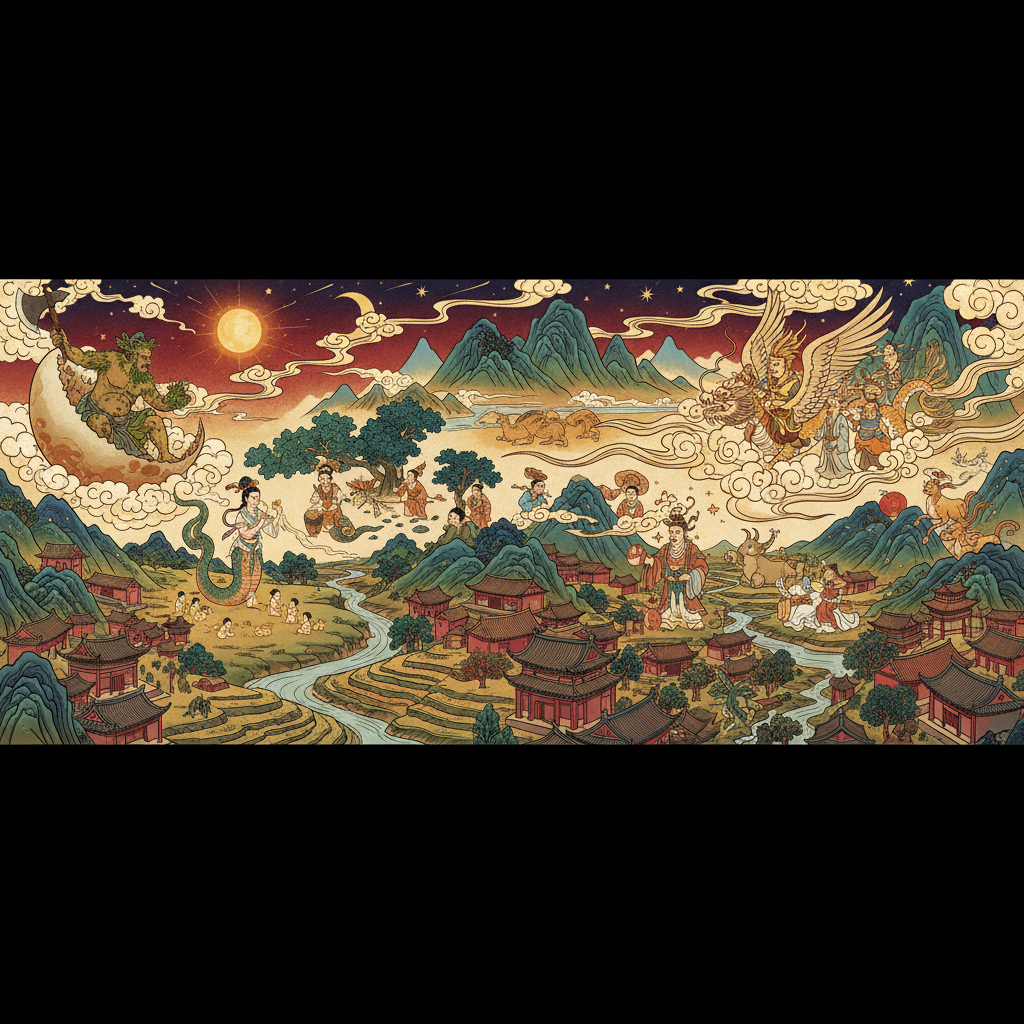
Introduction to Chinese Creation Myths
Chinese creation myths are an integral part of the nation's folklore, woven into the fabric of its cultural identity. These narratives not only reflect the beliefs and values of ancient Chinese society but also serve as a means of understanding the world and humanity’s place within it. Their significance extends beyond mere storytelling; they encapsulate historical context, moral lessons, and the philosophical underpinnings that characterize Chinese thought.
The Cosmic Creation: Pangu and the Birth of the Universe
One of the most prominent myths is that of Pangu, the primordial giant who is said to have created the universe. According to legend, in the beginning, there was only chaos—a dark, formless void. From this chaos emerged Pangu, who broke free from his cosmic egg and began to mold the universe. As he separated the heavens and the earth, he grew taller every day, eventually standing between the two realms.
This myth holds considerable cultural significance, embodying themes of transformation and balance. Pangu’s perseverance and struggle to establish order reflect the human experience of overcoming adversity. Additionally, his eventual death, wherein his body becomes part of the earth and sky, emphasizes the cyclical nature of life, a concept deeply rooted in Chinese philosophy.
Nuwa: The Goddess of Creation and Harmony
Another cornerstone of Chinese creation mythology is the tale of Nuwa, the goddess who fashioned humanity from clay. After Pangu's time, the world was plagued by chaos and monsters. In response, Nuwa descended to Earth and created humans to foster harmony. However, her clay figures were uneven, leading her to enhance their quality, resulting in the various classes of people.
Nuwa's actions and motivations are laden with meaning. Her maternal influence emphasizes the importance of nurturing and relationships in Chinese culture, highlighting the balance between yin and yang. Furthermore, her story of mending the sky after a cataclysm underscores a critical belief in restoration and the importance of maintaining balance in the world, values echoed in various cultural practices and traditions.
The Tao and Harmony in Creation Myths
In the lens of Taoist philosophy, the creation myths of China are seen as reflections of the universe's natural flow and inherent order. The Tao, or "Way," is the underlying principle that governs all aspects of life and nature. Creation stories often echo the Taoist belief in achieving harmony with the cosmos, reinforcing the idea that humanity is an integral part of the universe’s grand tapestry.
These myths inspire various cultural traditions such as Tai Chi and Feng Shui, where achieving balance and harmony is paramount. The teachings derived from these creation stories resonate throughout Chinese history, influencing art, literature, and even political thought.
Cultural Traditions Inspired by Creation Myths
The influence of Chinese creation myths extends into several cultural traditions and festivals. For instance, the story of how Nuwa repaired the sky inspires the popular myth during festivals honoring the earth, where people express gratitude for the land and its resources. Cultural festivals often include art forms that depict these legends, illustrating the enduring legacy of these narratives in visual storytelling.
Moreover, these myths inform the values taught in Chinese families and schools. Concepts of diligence, perseverance, and the interconnectedness of all things rooted in these creation stories instill a sense of cultural pride and collective responsibility in younger generations.
Conclusion: The Enduring Legacy of Chinese Creation Myths
Chinese creation myths are not just quaint stories from a bygone era; they are living narratives that continue to shape cultural identity and moral values. Through tales like that of Pangu and Nuwa, the ancient Chinese articulated their understanding of the universe, humanity’s role within it, and the importance of balance and harmony.
As modern society navigates complexities and changes, the lessons derived from these myths remain relevant. They serve as a reminder of the interconnectedness of life and the importance of preserving culture in the face of modernization. The enduring power of these stories lies in their ability to connect past wisdom with contemporary thoughts, making Chinese creation myths a vital part of cultural tradition and identity.